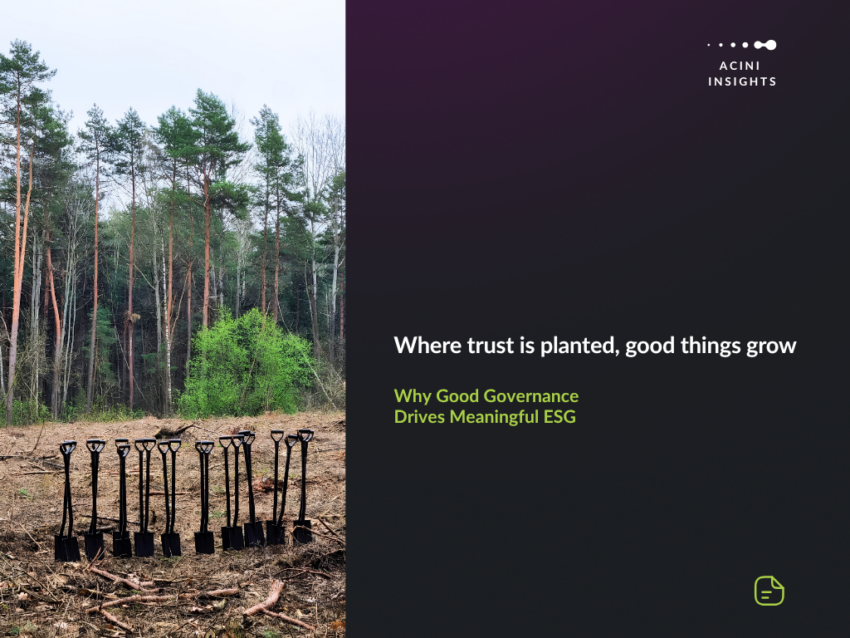
Most ESG programmes start with policies. Ours started with trust.
When people hear the term ESG, they often think about carbon emissions, sustainability reports or corporate initiatives designed to reduce environmental impact.
Those initiatives matter. But in our experience, they are rarely where meaningful ESG begins.
At Acini, ESG wasn’t introduced through a programme or a policy. It emerged naturally from the way we built the company.
Long before we spoke about ESG, we focused on something much more fundamental: how do we build an organisation where people trust each other, take ownership and are empowered to make decisions?
Looking back, we realised that good governance didn’t simply support ESG. It created the conditions for it.
Governance Before ESG
Many organisations launch ESG initiatives from the top down. New policies are introduced, committees are formed and targets are defined.
Our journey looked different.
We designed Acini around four principles:
• Transparency
• Decentralised decision-making
• Fair incentives
• Value-based partnerships
None of these principles were introduced as ESG initiatives. They were created because we believed they would help build a better consulting company. Over time, they also became the foundation for many of the environmental and social outcomes we’re proud of today.
Trust Creates Better Organisations
Governance isn’t about creating more control. It’s about creating the right environment for people to do their best work.
When people trust the organisation they work in, knowledge is shared more openly, people invest in one another, ideas emerge from every level of the business and initiatives become something employees create rather than something they are asked to join.
At Acini, this philosophy has translated into measurable outcomes:
• Employee Net Promoter Score (eNPS): 70
• 50/50 gender representation among Area Owners across six leadership areas
• 7% of working time invested in learning and development
• 11% of net profit shared with employees and consultants
• Four self-organised intercity events created from the bottom up
None of these outcomes appeared because they were mandated. They emerged because people were trusted.
Governance Creates Space for ESG
One of the biggest misconceptions about ESG is that organisations need to launch initiatives before people become engaged.
We’ve seen the opposite.
When governance creates ownership, people naturally begin building initiatives that matter.
Our ESG Working Group formed organically and today includes more than ten active members from across the organisation.
Employees decide how our Green Budget is used. As the company has grown, the budget has increased by 163% year over year, while greenhouse gas emissions per employee have remained relatively low.
Another example is our skills-based volunteering initiative. Instead of organising traditional volunteering days, our team committed around 400 hours of pro bono work to rebuild the website and knowledge base for the Wetlands Conservation Centre.
These projects weren’t created because someone introduced an ESG strategy. They happened because governance created the freedom for people to act.
Better Governance Builds Better Delivery
As an insurance technology consultancy, we see governance as more than an internal organisational topic.
It directly influences the quality of software delivery.
Stable teams collaborate more effectively. Knowledge stays within the organisation. Ownership improves decision-making. Continuous learning strengthens engineering capability.
Between 2024 and 2025, Acini grew by almost 60%, increased billable delivery by nearly 90% and delivered more than 50 insurance projects while continuing to invest in people, learning and community initiatives.
For us, business performance and ESG are not competing priorities. They reinforce one another.
Recognition Was Never the Goal
We’re proud that Acini was shortlisted for ESG Initiative of the Year at the Claims Excellence Awards 2026.
But the recognition itself isn’t the most important part of the story.
What matters is that it acknowledges a different way of thinking. Rather than treating ESG as a separate programme, we believe organisations should build governance models that naturally encourage responsible behaviour, continuous learning and long-term thinking.
When people trust the system they work in, good things grow.
Looking Ahead
Technology companies often ask how to build stronger cultures, improve delivery and create greater social impact.
Our experience suggests these challenges are closely connected.
Governance shapes behaviour.
Behaviour shapes culture.
Culture shapes outcomes.
ESG is not something organisations bolt onto an existing business. It is something that grows from the way the business is built.
As insurers continue to modernise and technology evolves, we believe organisations that invest in trust, transparency and shared ownership will be better equipped to deliver sustainable value for customers, employees and the wider industry.